How do you know whether you are training at the right intensity during an indoor cycling workout? The resistance level alone does not tell you much, as resistance settings vary between bikes. How you feel can also change from day to day. A pace that feels comfortable today may suddenly feel much harder after a short night’s sleep or a busy day.
This makes it difficult to compare workouts fairly. Are you genuinely training harder than you were a few weeks ago? Can you maintain the same effort for longer? And are you training at the intensity intended by the coach?
Wattage can help you answer these questions. It shows how much power you are producing through the pedals. By combining your wattage with your personal FTP and training zones, you can manage your effort more effectively and track your progress over a longer period.
But what exactly does wattage mean? Is a higher number always better? And how can you use wattage during an indoor cycling workout?
What is wattage
Wattage is the amount of power you are producing through the pedals at a particular moment. It shows how much work you are doing on the bike. Generally, the more forcefully you pedal, the higher your wattage will be.
Your wattage is determined by a combination of:
- The resistance on your bike.
- The force you apply to the pedals.
- Your cadence, or how quickly you pedal.
This means that pedalling quickly does not automatically produce a high wattage. With a high cadence and very little resistance, your power can remain relatively low. If you add resistance while maintaining the same pedalling rate, you will need to apply more force and your wattage will increase.
Conversely, you can also produce a high wattage at a lower cadence. Think of a demanding climb during which you pedal more slowly but use plenty of resistance.
Wattage therefore shows the result of your pedalling rate, force and resistance at that particular moment.
What is the difference between wattage and resistance?
Resistance and wattage are often confused, but they do not mean the same thing.
Resistance is a setting on your indoor bike. You use it to make pedalling feel lighter or heavier. Resistance levels can be displayed differently depending on the bike’s brand and model. Level 20 on one bike may therefore feel very different from level 20 on another.
Wattage is the result of the effort you are producing. It takes into account not only the resistance but also the speed and force with which you pedal.
You can use the same resistance and still produce different wattages:
- If you pedal slowly, your wattage will remain lower.
- If you increase your cadence, your wattage will rise.
- If you apply more force, your wattage may also increase.
Wattage is therefore often more useful than resistance alone when monitoring your effort.
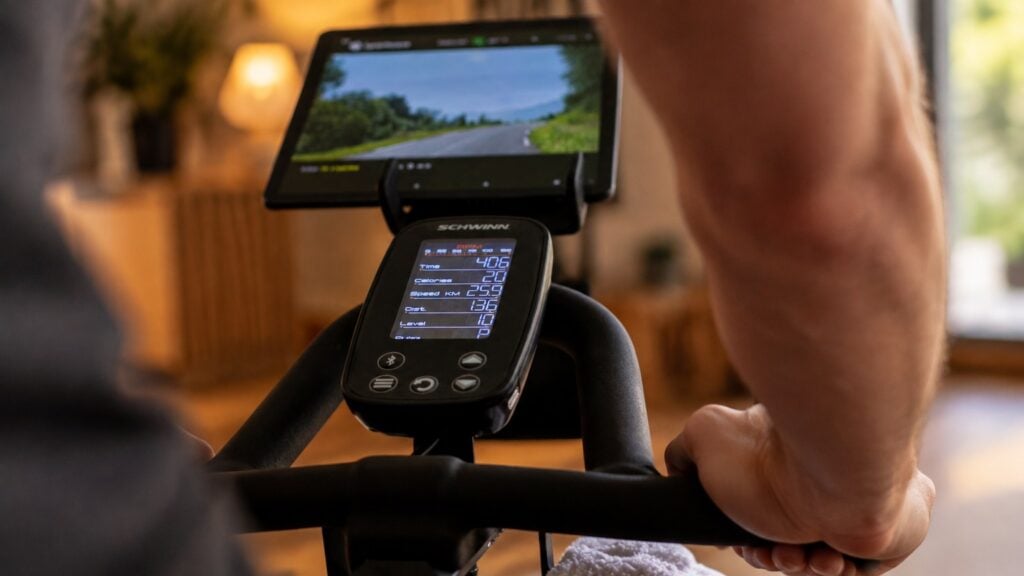
What does wattage tell you about your workout?
Wattage provides an immediate and objective measure of the power you are producing. As soon as you add resistance or start pedalling more forcefully, you will see the number change almost instantly.
This makes wattage useful for:
- Managing your effort during a workout.
- Performing intervals more consistently.
- Translating the coach’s guidance to your own level.
- Comparing similar workouts.
- Recognising progress over several weeks or months.
Suppose you try to maintain 150 watts during a three-minute interval. Monitoring your wattage allows you to see whether you are distributing your effort evenly. If you start at 190 watts but drop to 120 watts after one minute, you probably started too hard. If you remain close to 150 watts, you have managed your energy more effectively.
Wattage therefore does not simply help you train harder. More importantly, it helps you manage your effort more intelligently.
A higher wattage is not always better
It can be tempting to treat wattage as a score: the higher the number, the better the workout. In reality, it is not that simple.
The wattage someone can produce depends on factors including:
- Cardiovascular fitness.
- Experience.
- Muscle strength.
- Body weight.
- Fatigue and recovery.
- The duration of the effort.
- The bike and measurement method being used.
An experienced cyclist may be able to maintain 200 watts for an extended period. For someone who has only just started, the same power may represent a very demanding or even unachievable effort. That does not mean one person is training better than the other. They are simply training at different levels.
A higher wattage is not always the goal within your own workouts either. During a recovery track, your power should decrease. During a long endurance workout, you choose a lower wattage that you can maintain for longer. During a short sprint, your power can be much higher because the effort ends quickly.
The right wattage therefore depends on the purpose and duration of that part of the workout.
Why train with wattage?
You do not need to train with wattage to complete an effective indoor cycling workout. You can also rely on how you feel, your cadence, your heart rate and the coach’s guidance. Wattage does, however, provide additional information that can help you train with greater purpose.
You can see changes in your effort immediately
Wattage responds almost immediately when you add resistance or pedal more forcefully. This is particularly useful during short intervals. You do not need to wait for your heart rate to rise to see that you are working harder.
You can distribute your energy more effectively
Maintaining a particular power output or wattage zone reduces the chance of starting too hard. This gives you more control over your effort and makes it easier to complete an interval or an entire workout.
You can compare workouts more accurately
Resistance levels and perceived effort can be difficult to compare. Wattage provides a more concrete value. When you use the same bike under similar conditions, you can monitor how your power develops over a longer period.
You can train more specifically
Different wattage zones serve different training purposes. A lower zone may be suitable for endurance training or recovery, while a higher zone is more appropriate for short, intense efforts.
You train at your own level
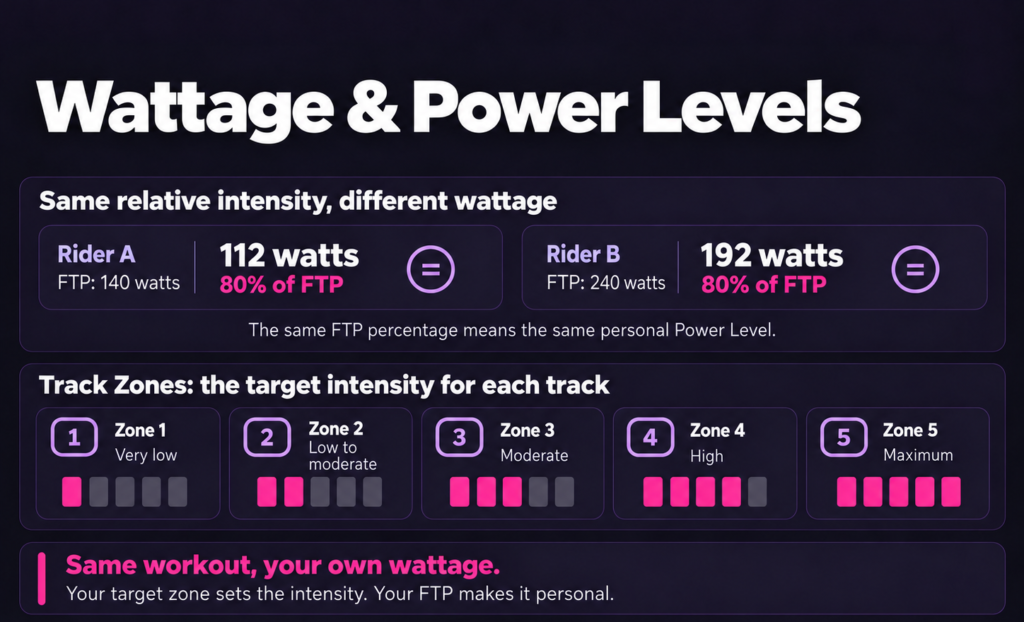
With personal wattage zones, you do not need to produce the same wattage as the coach or another rider. CycleMasters compares your power with your personal FTP and converts it into a percentage. Each Power Level therefore represents a comparable relative intensity for every rider, even when their actual wattages differ.
How is wattage measured?
Some indoor bikes measure the power you produce directly. Others calculate or estimate wattage using data such as resistance and cadence. Separate power meters are also available, including power meter pedals.
Not every measurement method is equally accurate. Different brands may also use different calculations. As a result, 180 watts on one indoor bike may not be exactly the same as 180 watts on another model.
That does not immediately make the value unusable. Consistency is particularly important when tracking your own progress. Ideally, use the same bike and compare workouts that are as similar as possible. This reduces differences caused by the equipment.
Do you use different bikes? In that case, focus mainly on your personal zones and how the effort feels instead of comparing the absolute wattages directly.
What is FTP?
You can use your FTP to determine which wattage is appropriate for your level. FTP stands for Functional Threshold Power. It is an estimate of the high power output you can maintain for an extended period.
Your FTP is expressed in watts and serves as a personal reference value. It can be used to calculate your different wattage zones.
Suppose two riders complete the same workout. The first rider has an FTP of 140 watts and the second has an FTP of 240 watts. Their target wattages during an intense part of the workout will probably be very different. Nevertheless, they can both ride in the same personal training zone and produce a similar relative effort.
That is exactly why FTP is useful: it gives context to your wattage. Without a personal reference value, 180 watts is just a number. With your FTP, you can assess how intense that power is for you.
How do you determine your FTP?
There are several ways to determine your FTP. Some training platforms use a dedicated FTP test. During this test, you produce the highest power you can maintain reasonably consistently for a set period. Your FTP is then calculated based on the result.
Such a test can be demanding and is not immediately necessary for every beginner. You can also start with an estimated FTP based, for example, on your experience level and body weight. This provides an initial personal breakdown of your wattage zones.
Do you already have an FTP value from a previous test, your bike computer or another training platform? You can use that value as your starting point.
Your FTP does not remain the same forever. It may increase as your cardiovascular fitness and power improve. After an extended break from training, it may decrease. It is therefore worth reassessing your FTP occasionally, particularly if your zones consistently feel too easy or too difficult.
What are wattage zones?
Wattage zones divide your power into different intensity levels. They are calculated as a percentage of your FTP, which means that they are tailored to your personal ability.
CycleMasters compares the wattage you produce during a workout with your configured FTP. The result is expressed as a percentage. If you ride at exactly your FTP, for example, you are producing 100% of your FTP. If you ride at a lower or higher wattage, the percentage will be below or above 100%.
These percentages are then divided into personal zones. During the workout, you are therefore not following one fixed wattage that is the same for everyone. Instead, you see a target zone that corresponds to a percentage of your own FTP. CycleMasters performs this calculation for you.
For example, one rider might have an FTP of 140 watts while another has an FTP of 240 watts. They can ride within the same Power Level while producing different absolute wattages. The numbers differ, but their relative intensity is comparable. This allows everyone to complete the same workout at their own level.
CycleMasters uses Track Zones ranging from 1 to 5:
| Track Zone | Intensity | How does it feel? | Possible application |
|---|---|---|---|
| Zone 1 | Very low | Very light and relaxed | Warm-up and recovery |
| Zone 2 | Low to easy | Comfortable and easy to maintain | Easy endurance effort |
| Zone 3 | Moderate | A noticeable effort, but manageable | A steady, longer effort |
| Zone 4 | High | Hard and challenging | Intense intervals |
| Zone 5 | Maximum | Very hard and sustainable only briefly | Sprints and peak efforts |
A Track Zone is not a fixed wattage that is the same for every rider. It indicates the desired intensity for that part of the class. CycleMasters uses your FTP percentage to determine the corresponding personal Power Level.
This allows a beginner and an experienced cyclist to complete the same workout together. Both work towards the same relative intensity but do so at wattages that suit their individual ability.
How to use wattage during an indoor cycling workout
When your bike transmits wattage data and your FTP is configured correctly, you can follow your current Zone and the Target Zone during a workout.
The Target Zone indicates the intensity at which you should train during the current track. The value shown under Zone indicates the personal zone in which you are currently riding. CycleMasters calculates this zone by converting your current wattage into a percentage of your FTP.
Are you below the Target Zone? You can:
- Add a little more resistance.
- Increase your cadence.
- Make a small adjustment to both resistance and cadence.
Are you above the Target Zone? Reduce your resistance, lower your pedalling rate or do both. Try to make gradual adjustments. If you continually make large changes, your effort will become inconsistent and you may repeatedly move from below to above the desired zone.
Give yourself some time to find the right rhythm and resistance level. You do not have to produce exactly the same wattage every second. Small fluctuations are perfectly normal.
Combining wattage and cadence
Wattage shows how much power you are producing. Cadence shows how quickly your pedals are turning. Together, these values provide more information than either number on its own.
You can, for example, achieve the same wattage with:
- A higher cadence and less resistance.
- A lower cadence and more resistance.
Both combinations can feel different and place a different emphasis on your training. A high cadence requires speed and control in your pedal stroke. A lower cadence with more resistance generally requires more force.
During a CycleMasters workout, the coach provides guidance on pace, resistance and execution. Use your wattage to check whether this combination is taking you towards the required Track Zone. Continue to pay attention to your posture and pedalling technique as well. A higher wattage is of little value if your movement becomes uncontrolled or your technique starts to suffer.
Combining wattage and heart rate
Wattage and heart rate each tell a different part of the story.
Wattage shows the power you are producing. Heart rate shows how your body responds to that effort. Your wattage changes almost immediately when you start pedalling harder or more gently. Your heart rate generally needs more time to respond.
This difference is particularly noticeable during short intervals. During a sprint, your wattage may rise sharply straight away, while your heart rate increases later. Your heart rate may even continue rising after the hardest part of the effort has already ended.
Combining both values can help you recognise useful developments. Can you produce the same wattage during a comparable workout with a lower heart rate? Or does a power output that once felt difficult now feel more manageable? That may indicate progress.
A higher heart rate at the same wattage is not necessarily a problem. Heat, stress, caffeine, sleep, hydration and recovery can all influence your heart rate.
How can you recognise progress?
Progress does not simply mean increasing your highest wattage. One brief peak says little about your overall development. It is more useful to examine patterns across several comparable workouts.
Possible signs of progress include:
- You can maintain the same wattage for longer.
- You can produce more wattage at a similar perceived effort.
- Your heart rate remains lower at the same power output.
- You perform intervals more consistently.
- You recover more quickly between intense efforts.
- You can maintain the desired zone more effectively.
- Your FTP increases over a longer period.
Ideally, compare the same workout or similar classes. Comparing a steady endurance workout with a short interval workout will not tell you very much. Also consider the bike you used and circumstances such as sleep, temperature and recovery.
Assess your progress over several weeks rather than judging it based on one workout. Everyone has days when their legs are less cooperative. Unfortunately, even your wattage meter cannot schedule a meeting with them.
Common mistakes when training with wattage
Trying to produce the highest possible number
The goal is not to improve your maximum wattage during every workout. The appropriate power depends on the training objective. Remaining in a lower zone may be exactly what the workout requires.
Comparing yourself with other riders
Absolute wattages mean little without information about factors such as experience, body weight and FTP. Compare your results primarily with your own previous workouts.
Starting too hard
A high wattage may feel good at the beginning of an interval, but it could cause your power to fall sharply later. Try to distribute your effort more evenly from the start.
Using an incorrect FTP
If your FTP is set too high, the zones may feel unachievable. If it is too low, the zones may not provide enough of a challenge. Adjust the value if it consistently fails to match your level.
Looking only at the screen
Wattage is a tool, not a replacement for listening to your body. Continue to monitor your breathing, posture, technique and perceived effort. Reduce your intensity if you experience pain, feel dizzy or can no longer control your movement.
Comparing different bikes directly
Measurement methods can vary between brands and models. For more reliable comparisons, use the same indoor bike whenever possible.
Do you need wattage to train effectively?
No, wattage is not essential for an effective indoor cycling workout. Without power measurement, you can use:
- The workout’s Track Zone.
- The coach’s guidance.
- Your breathing.
- Your cadence.
- Your heart rate.
- How demanding the effort feels.
Wattage is particularly useful when you want more insight into the power you are producing. It helps you manage intervals, follow personal zones and make your progress over time more visible.
Does your indoor bike not measure wattage? You can still train with purpose. A heart rate monitor or cadence sensor can provide additional information, but you can also follow the intensity of the Track Zones based on perceived effort without any connected sensors.
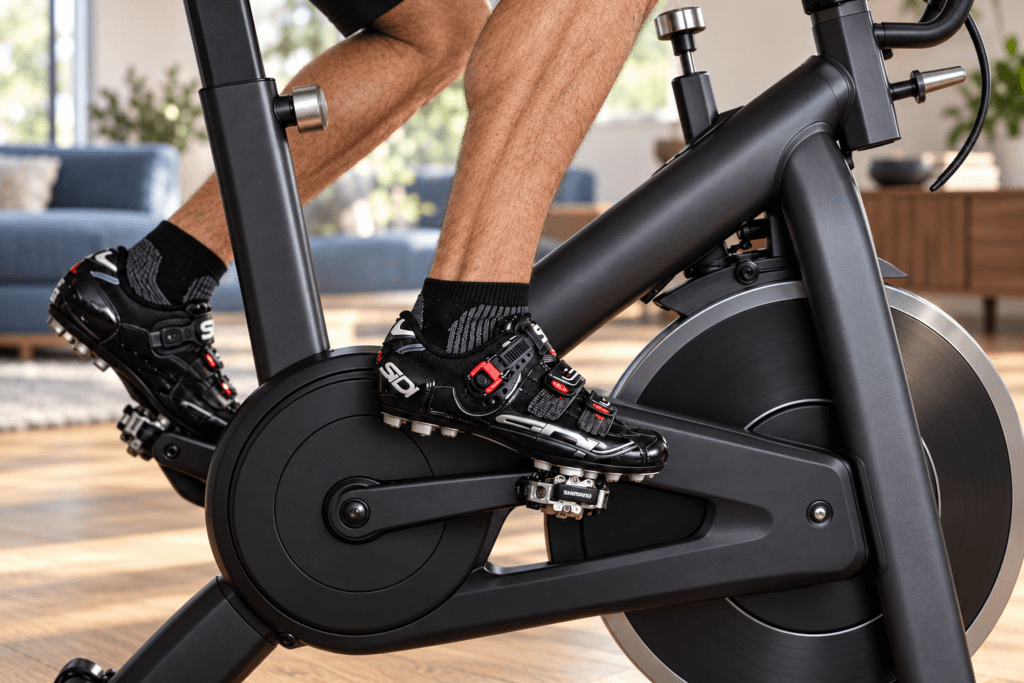
Getting started with wattage training
Would you like to start using wattage during your workouts? Keep it simple at first:
- Check whether your indoor bike measures and transmits wattage.
- Connect your bike to the CycleMasters app.
- Enter your FTP or allow the app to estimate a starting value.
- Use the Track Zone as your main guide during the workout.
- Adjust your resistance and cadence gradually.
- Pay attention to your technique and perceived effort as well as the numbers.
- Compare several similar workouts after a few weeks.
You do not need to analyse every number during your first workout. Start by following your current Zone and the Target Zone. Once that feels familiar, you can combine your wattage with your cadence and heart rate.
Train based on your own power with CycleMasters
Wattage shows how much power you are producing through the pedals. It helps you distribute your effort more effectively, perform intervals more consistently and compare similar workouts. Combined with your personal FTP and wattage zones, the number also becomes meaningful for your own level.
It remains important not to treat wattage like a score. More is not always better. The right power output is the one that suits the purpose of the track, your level and how your body is responding that day.
When you connect a bike with wattage measurement to CycleMasters, CycleMasters converts your current wattage into a percentage of your FTP. That percentage determines your personal Power Level and shows which zone you are riding in. Instead of chasing one general wattage target, you train at an intensity that is right for you.